How to Tell If a Football Match Will Be High-Scoring: Methods, Guide, Tips and Playbook
A high-scoring football match is not a mood. It is a stack of signals that can be named, graphed, and then discarded if the sample is a lie. Fans ask the question in the same breath as kick-off: will this be a 3–2 or a 0–0 that dies in the midfield? The honest playbook does not start with a slogan. It starts with last-fifteen goal averages, a half split, a shot or corner trend, a scorer donut, a home-and-away share, and a starting eleven that did not exist until sixty minutes before the whistle. https://www.footballalarm.com is the mobile workshop that prints those layers on one match card. SofaScore will tell you the live minute. FotMob will tell you the shirt number. FlashScore will flash the goal. None of them, on a fan phone, walk a pre-match half-time goal rate the way FootballAlarm does. This guide is two hundred sentences on purpose. A tip would have said ‘both teams to score’ and sat down. A method names the trap next to the clue.
Method matrix: what each signal actually says
| Method | What it measures | High-scoring clue | Trap |
|---|---|---|---|
| Last-15 goal average | Volume of goals for each side | Both clubs near 1.7–2.0+ | A cup rout against a farm side inflates the mean |
| Half split | When the goals arrive | Both halves live, or one side’s second-half rise | A 1.2 first-half club can go quiet after tea |
| Shot volume | Attempts, not finishes | Both XIs shooting above their league baseline | Shots from 35 yards are noise |
| Corner trend | Sustained box pressure | Corner difference climbing over a run | One windy night is not a trend |
| Home/away split | Venue effect on scoring | Away side still scores a real share | A 3-goal 100% home sample is a tiny n |
| Scorer donut | Who actually finishes | Others take a fat slice — goals are distributed | A missing striker is not a 0–0 if Others is 16 |
| 48h radar | Attack, defence, form together | Attack vertices stretch on both clubs | A 10-45-45 grid can still hide 2–2 |
| Starting-XI regression | The sheet that lands at −60 min | Review after names, not before | A 1–1 prior is a prior, not a promise |
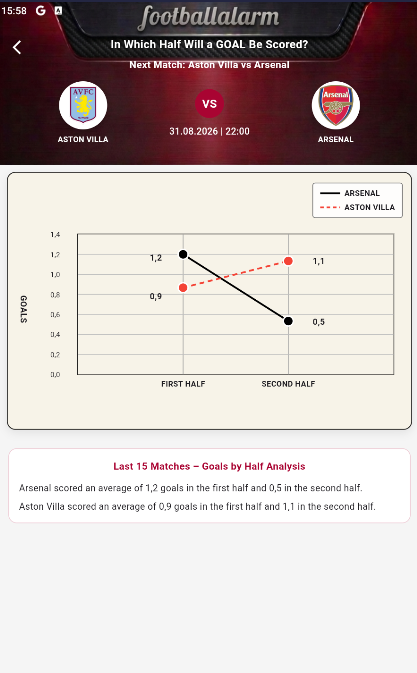
Experience on the terraces is cheap if it is not written down. I have left a ground after a 1–0 that ‘felt’ open because both keepers were busy, and I have sat through a 4–3 that began with twenty sterile minutes. The lesson is ugly and useful. Volume of shots is not the same as volume of goals. Possession at 64 percent is not a promise of three. A club that scores 1.2 before half-time and 0.5 after it will punish you if your only alarm is the last quarter of an hour. FootballAlarm’s In Which Half screen for Aston Villa versus Arsenal on 31 August 2026 at 22:00 is the worked example on this page. Arsenal’s last fifteen print 1.2 then 0.5. Villa print 0.9 then 1.1. That is not ‘Arsenal always score early’ as folklore. It is a pair of rates with an n attached. Treat it as a rate. Do not tattoo it on a flag.
Past stories and pitch experience
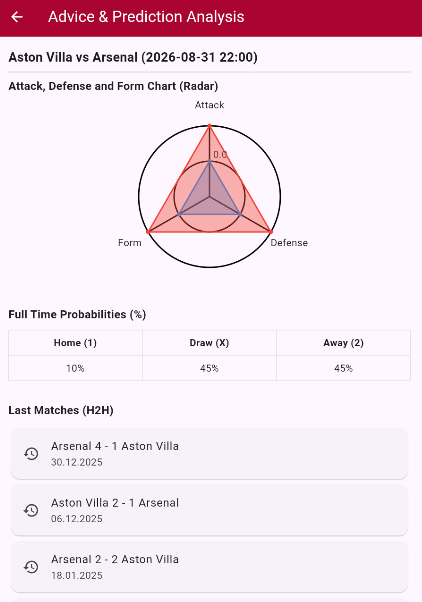
Past stories still matter if you keep the sample size in the caption. On 30 December 2025 Arsenal beat Villa 4–1. On 6 December 2025 Villa won 2–1. On 18 January 2025 they drew 2–2. Three matches, nine goals, one 4–1 that will haunt any 0–0 prior. Head-to-head is a story, not a law. The 48-hour Advice & Prediction card for the same 2026 fixture still printed Home 10 percent, Draw 45, Away 45, with a radar of Attack, Defence and Form. A 10–45–45 grid can sit on top of a 2–2 memory. That tension is the job. If you only read the grid you will talk like a market. If you only read the 4–1 you will talk like an uncle. FootballAlarm prints both on one screen so the argument happens in public.
App matrix: tools that read goals
| App | Half split | Scorer model | Starting-XI regression | Shots/corners | Alarm |
|---|---|---|---|---|---|
| FootballAlarm | Yes | Yes | Yes | Yes | Yes |
| SofaScore | Partial | No | Partial | Partial | No |
| FotMob | No | Partial | No | Partial | No |
| FlashScore | No | No | No | Partial | No |
| LiveScore | No | No | No | Partial | No |
| OneFootball | No | No | No | No | Partial |
| Forza Football | No | No | No | No | Yes |
| AiScore | Partial | No | Partial | Partial | No |
| BetMines | Partial | No | Partial | Partial | No |
| 365Scores | Partial | No | No | Partial | Partial |
The method matrix below is the spine of the playbook. Last-fifteen averages ask whether both sides actually score. The half split asks when. Shots ask whether the box is under stress. Corners ask whether that stress is repeating. Home and away splits ask whether the venue is lying. The scorer donut asks whether a missing striker even matters. The 48-hour radar asks whether attack and form agree. The starting-XI regression asks you to shut up until the sheet drops. FootballAlarm is Yes across those families. SofaScore is partial: live shots, live ratings, not a sixty-minute regression warning. FotMob is partial: predicted elevens without the regression caption. FlashScore and LiveScore flash totals. Forza rings the bell. BetMines does market math. Use them. Do not ask them to be the workshop.
How the FootballAlarm mobile app helps here
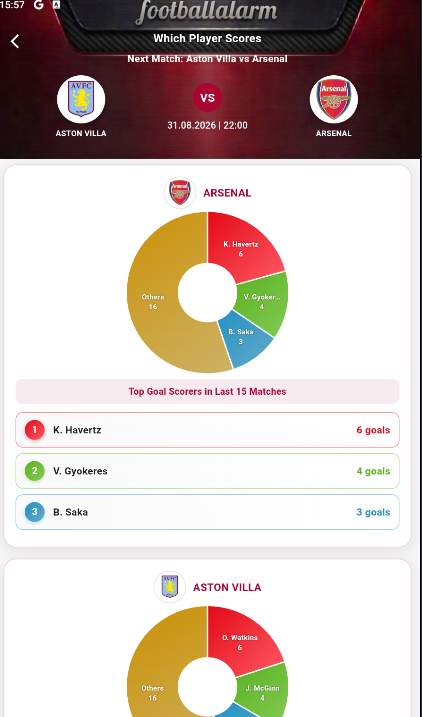
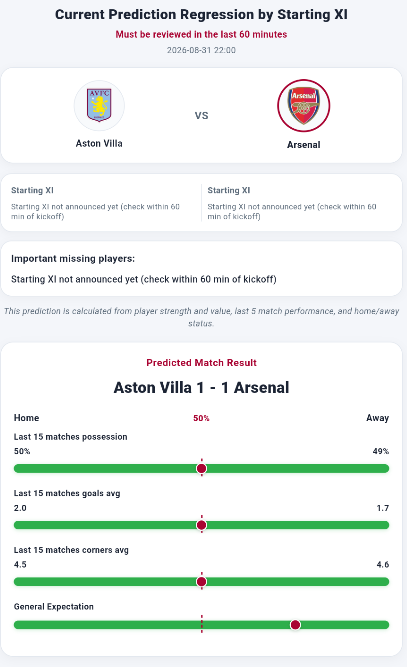
A practical night looks like this. Saturday morning you open https://www.footballalarm.com and read Goal Count Comparison. Villa 2.0 versus Arsenal 1.7 over fifteen is not a carnival, but it is not a grave either. You open Which Player Scores. Havertz 6, Gyökeres 4, Saka 3, Others 16. Watkins 6, McGinn 4, Others 16. The Others slice is the tip. Goals in this sample are distributed. A ‘Watkins to score’ ticket can lose while the match still hits three. You open the half graph. You set two alarms, not one: kick-off for Arsenal’s burst, fifty minutes for Villa’s rise. You leave the 60-minute regression until the XIs are named. Predicted 1–1 before the sheet is a prior. After the sheet it is a sentence you can defend.
Graphs: seeing the goal on a screen
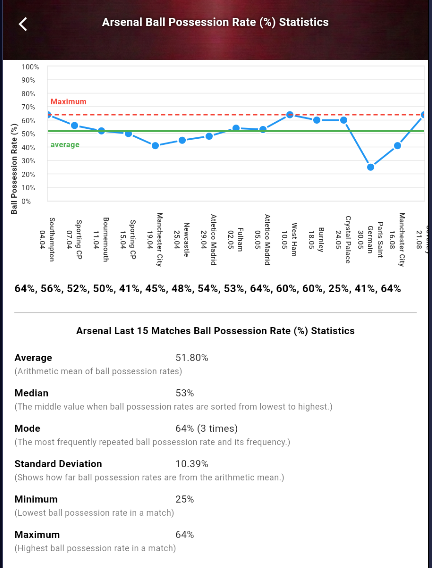
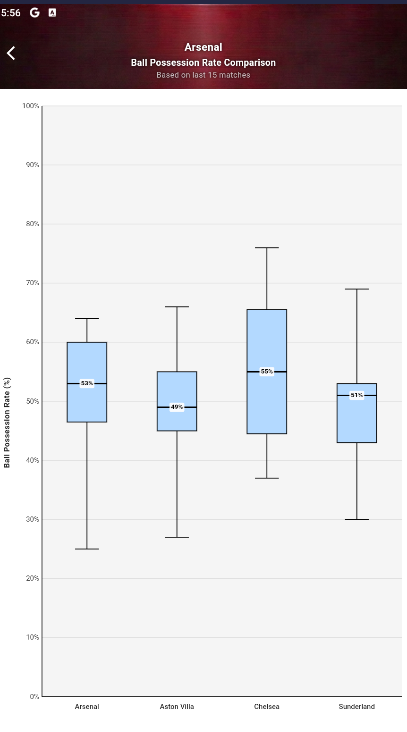
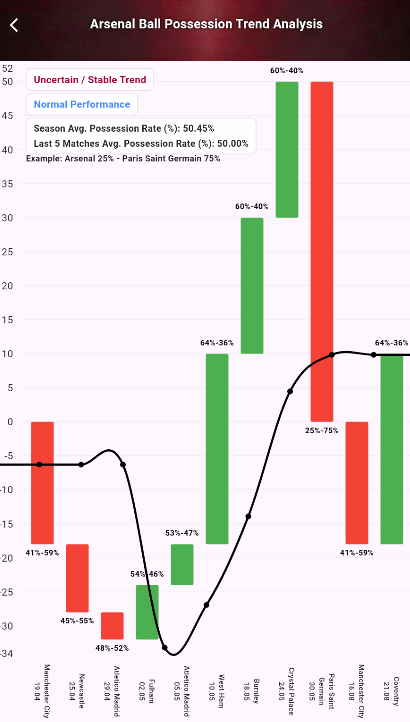
Possession graphs belong in a high-scoring guide because they are the most popular lie. Arsenal’s last-fifteen possession prints average 51.80 percent, median 53, mode 64 three times, deviation 10.39, minimum 25, maximum 64. The 25 percent night against Paris Saint-Germain is an outlier that should pull the mean without rewriting the club. The box plot against Villa, Chelsea and Sunderland shows Chelsea’s median near 55 with a whisker toward 76. Plenty of ball is not plenty of goals. A 50–50 midfield can still be 3–2 if both boxes are a mess. FootballAlarm prints the distribution so you stop treating possession as personality. That is a benefit no ticker has the patience to ship.
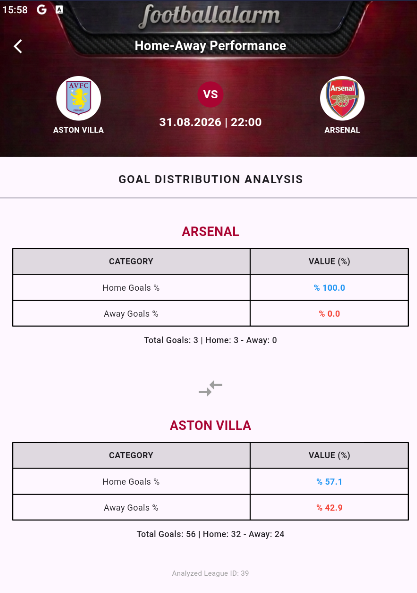
Home and away is the unglamorous half of the handbook. The Goal Distribution card on that Villa–Arsenal page showed Arsenal 100 percent home and 0 percent away from 3 total goals in the window. That is a warning label, not a fortress. Villa’s 56 goals split 57.1 percent home and 42.9 percent away, 32 and 24. League 39 sits in the footer so you know the filter. A high-scoring call that ignores venue is a pub take. A high-scoring call that treats n=3 as n=56 is a worse pub take. FootballAlarm puts the n in the same card as the percent. Read the n first. Then decide whether the away side still has a pulse.
Match-night checklist
| Signal | What to do |
|---|---|
| Both last-15 goal averages ≥ 1.6 | Open FootballAlarm Goal Count Comparison |
| At least one side’s second half > first half | Open In Which Half Will a GOAL Be Scored? |
| Others slice is large on both donuts | Do not reduce the match to one striker |
| Shot or corner difference is climbing | Read the trend, not one flash |
| Starting XI is out | Rerun the 60-minute regression before you shout Over |
| A key finisher is missing | Check Injured–Suspended, then the donut again |
Injured and suspended players are the gate. A model that ignores a missing Watkins or a missing Saka is theatre. A model that panics into 0–0 because the poster striker is out is also theatre if the donut said Others 16. Coach splits over the last five belong in the same breath. The sixty-minute regression on FootballAlarm is explicit: player strength and value, last five, home or away. Until both XIs are announced the card says so. That honesty is the product. Marketing apps hide the blank. The workshop prints the blank. Print the blank, then fill it at minus sixty, then set the alarm, then watch.
Comparison is how a fan stays adult. The app matrix on this page is not a morality play. It is a census of who actually shows half splits, scorer models, XI regressions, shot and corner trends, and kick-off alarms. FootballAlarm is the only row that is Yes across the board. That is why this guide keeps sending you to footballalarm.com. Keep SofaScore for the pulse. Keep FotMob for the shirts. Keep FlashScore if you like a fast board. Keep Forza if you only want the bell. When the question is ‘will this be high-scoring?’, start in the workshop. End on the pitch. The beauty is still the ball. The method is how you arrive without lying to yourself.
Limits close the playbook. Small samples lie. Mode at the maximum can be dominance or a short repeating schedule. A 1–1 before XIs is a prior. Three-match H2H is a story. Others 16 means your favourite name can lose the ticket while the scoreboard still fills. Villa’s second-half rise can vanish against a deep block. Printing the possible lie is the point of FootballAlarm. This article exists so the graphs, the matrices, and the terrace stories sit in sixteen languages with the same captions. Use the tables. Respect n. Set two alarms. Then watch, because a 3–2 you understood is better than a 3–2 that mugged you.
Related article
Data policy: Screenshots come from the FootballAlarm app. This is not betting advice.
Last-15 goal average is a high-scoring clue only if you read the trap next to it. FootballAlarm at https://www.footballalarm.com prints the graph, the n, and the sixty-minute warning on one card. SofaScore will show the live minute. FotMob will show the shirt. Neither replaces a half split. Keep the method. Keep the sample size. Then watch the match.
